Safest Crypto Exchanges in 2026 (Ranked by Default Risk)
Summary: Coinbase is the safest major crypto exchange according to Agio Ratings' default risk data, with a 1.44% probability of default over the next 12 months. Binance (1.70%) and OKX (2.09%) round out the top three. These are the first public rankings under Agio Ratings' v3.2 CEX risk model, the most significant update since the model launched in 2022.
At Agio Ratings, we've been measuring exchange creditworthiness since 2022. Agio Ratings combines daily transactions, operating risk factors, and regulatory information to quantify crypto counterparty risk for institutional traders, underwriters, and risk teams. Agio Ratings flagged FTX's elevated default risk four months before bankruptcy, when traditional credit agencies had not covered FTX and institutional investors were caught flat-footed.
In this post, we use Agio Ratings' proprietary risk data to show which exchanges are the safest for institutional investors. Each exchange is ranked using the latest output from Agio Ratings' v3.2 CEX risk model as a point-in-time snapshot.
What Is Exchange Default Risk?
Default risk measures the probability that an exchange fails to return assets over a defined time horizon. Agio Ratings quantifies this as a 12-month probability of default (PD). Default scenarios include bankruptcy, insolvency, security breaches that result in permanent asset loss, and regulatory seizure.
For anyone holding assets on an exchange, PD gives a single number to compare counterparty credit risk across platforms with different structures, jurisdictions, and business models. It answers a straightforward question: what are the odds this exchange suspends withdrawals for a prolonged period within the next 12 months?
Traditional credit agencies like Moody's and S&P do not cover most crypto exchanges. Their models were not built for digital asset risk factors like on-chain transaction volatility, quality of new or emerging licenses, or even trading volume. That leaves risk managers to rely on reputation, regulatory status, and gut feel. Agio Ratings fills that gap with quantitative methodology built for digital asset markets.
The 8 Safest Crypto Exchanges in 2026
These rankings are based on Agio Ratings' 12-month probability of default as of March 31, 2026. They are not investment advice or endorsements.
Rank: 1 | Exchange: Coinbase | 12-Month PD: 1.44%
Rank: 2 | Exchange: Binance | 12-Month PD: 1.70%
Rank: 3 | Exchange: OKX | 12-Month PD: 2.09%
Rank: 4 | Exchange: Crypto.com | 12-Month PD: 2.81%
Rank: 5 | Exchange: Bybit | 12-Month PD: 3.14%
Rank: 6 | Exchange: Bitpanda | 12-Month PD: 3.44%
Rank: 7 | Exchange: Gemini | 12-Month PD: 3.48%
Rank: 8 | Exchange: Bitget | 12-Month PD: 3.73%
How Agio Ratings Measures Exchange Risk (v3.2)
Agio Ratings' v3.2 CEX risk model scores 17 risk indicators for each exchange, spanning on-chain reserves, trading volume, web traffic, employee headcount, regulatory licenses, and asset volatility. The model groups these indicators into five latent risk dimensions: size, trajectory, volatility, age, and regulatory strength. The shared credit risk signal across all five drives the final probability of default.
The model's discrimination accuracy (AUC) comes in at 0.864, placing it at the upper end of the 0.70 to 0.90 range typical of traditional credit models. Coinbase's Agio Ratings score tracks its stock price with an R² of 91%, providing independent market validation of perceived risk.
For the full breakdown of what changed in v3.2, including the recalibrated default rates and new weighting methodology, read the model update here.
These rankings are a point-in-time snapshot. Exchange risk moves daily as on-chain flows, leverage ratios, and operational metrics shift. Agio Ratings updates scores daily across 40+ exchanges, giving risk teams a live view rather than a quarterly report.
1. Coinbase — 1.44% Default Probability
The lowest default risk among major crypto exchanges. Coinbase's rating is driven almost entirely by structural strength, not momentum.
Coinbase carries the lowest 12-month probability of default of any major exchange at 1.44%. Under Agio Ratings' v3.2 model, that figure closely aligns with S&P's BB- credit rating for Coinbase Global, which implies a probability of default around 1.18%.
Coinbase scores highly on exchange maturity, license score, and company size, the strongest combination of regulatory and institutional credibility on this list. No other exchange matches that profile. In May 2025, Coinbase became the first crypto company included in the S&P 500. As of mid-2025, Coinbase reported $425 billion in assets on platform. Public company status means investors and risk teams can review the balance sheet directly.
What makes Coinbase's rating distinctive is where the strength comes from. The three highest scores (company size, maturity, license) are all structural indicators that change slowly. These are the variables least likely to deteriorate quickly in a market downturn, which is exactly why the PD sits at the top of the ranking.
Where Coinbase trails: On-chain balance trend (22) and flow trend (17) are both weak. Coinbase's on-chain reserves have been shrinking and net flows are negative. These trend scores are low across the entire top 8, so this reflects a broader market pattern more than a Coinbase-specific issue. But it does mean Coinbase's rating rests on institutional durability rather than growing on-chain activity. Risk teams comfortable with that tradeoff will find Coinbase the most straightforward counterparty to underwrite.
2. Binance — 1.70% Default Probability
The world's largest exchange by trading volume. Binance earns its ranking through operational capacity that no other exchange can match at scale.
- Variable: Company Size | Score: 95
- Variable: User Traffic | Score: 95
- Variable: Trading Volume Leverage | Score: 82
- Variable: On-Chain Flow Leverage | Score: 93
- Variable: On-Chain Balance Trend | Score: 18
- Variable: On-Chain Flow Trend | Score: 26
- Variable: On-Chain Balance Volatility | Score: 94
- Variable: On-Chain Flow Volatility | Score: 95
- Variable: Exchange Maturity | Score: 65
- Variable: License Score | Score: 85
- Variable: 12-Month Probability of Default | Score: 1.70%
Binance carries a 1.70% probability of default, just 26 basis points behind Coinbase.
Binance dominates the operational flow metrics that other top exchanges cannot match. On-chain flow volatility (95), balance volatility (94), and flow leverage (93) are the highest scores in those categories among the top-ranked exchanges. These numbers reflect Binance's ability to process very large volumes without reserve instability. Where Coinbase reaches its low PD through maturity and licensing, Binance reaches a comparable outcome through raw operational throughput and reserve stability under stress.
Binance's regulatory footprint has also expanded materially, including a comprehensive license under Abu Dhabi's ADGM framework. The license score of 85 reflects meaningful progress from the exchange's earlier years when regulatory uncertainty was a more visible risk factor.
Where Binance trails: Exchange maturity (65) and license score (85) sit below Coinbase's 95 on both. The 26-basis-point gap between the two exchanges traces almost directly to these two dimensions. On-chain balance trend (18) and flow trend (26) also show weaker momentum than the strongest names on this list. For trading firms prioritizing operational liquidity and flow capacity, Binance's profile is hard to match. For compliance-driven allocators who weight licensing above all else, the gap to Coinbase still matters.
3. OKX — 2.09% Default Probability
The most balanced risk profile in the top three, with stronger reserve momentum than Coinbase or Binance.
- Variable: Company Size | Score: 95
- Variable: User Traffic | Score: 93
- Variable: Trading Volume Leverage | Score: 86
- Variable: On-Chain Flow Leverage | Score: 90
- Variable: On-Chain Balance Trend | Score: 29
- Variable: On-Chain Flow Trend | Score: 39
- Variable: On-Chain Balance Volatility | Score: 48
- Variable: On-Chain Flow Volatility | Score: 93
- Variable: Exchange Maturity | Score: 84
- Variable: License Score | Score: 92
- Variable: 12-Month Probability of Default | Score: 2.09%
OKX carries a 2.09% default probability, placing it third among major exchanges.
OKX has the best balance and flow trend scores of the top three. Balance trend (29) and flow trend (39) are both the highest among Coinbase, Binance, and OKX, suggesting that OKX's on-chain reserves are declining less (or growing more) than its two closest competitors. Flow leverage (90) and flow volatility (93) are also strong. The license score (92) places OKX closer to Coinbase's regulatory profile than to Binance's, and maturity at 84 shows meaningful operational track record.
The overall picture is an exchange without a glaring weakness in any single dimension. OKX does not lead on structural credibility like Coinbase or on operational scale like Binance, but it avoids the wide score gaps that widen PD for exchanges further down the list.
Where OKX trails: Balance volatility (48) is the weakest in the top three, meaning on-chain reserves fluctuate more relative to their size. OKX also lacks Coinbase's public company transparency, which limits the depth of independent financial analysis risk teams can perform. For allocators who want a single counterparty with strong scores across licensing, flow metrics, and trend indicators, OKX offers the most even distribution of any exchange in the ranking.
4. Crypto.com — 2.81% Default Probability
Strong infrastructure and flow capacity, but weaker user activity signals keep the rating behind the top three.
- Variable: Company Size | Score: 95
- Variable: User Traffic | Score: 58
- Variable: Trading Volume Leverage | Score: 87
- Variable: On-Chain Flow Leverage | Score: 95
- Variable: On-Chain Balance Trend | Score: 16
- Variable: On-Chain Flow Trend | Score: 19
- Variable: On-Chain Balance Volatility | Score: 67
- Variable: On-Chain Flow Volatility | Score: 48
- Variable: Exchange Maturity | Score: 61
- Variable: License Score | Score: 85
- Variable: 12-Month Probability of Default | Score: 2.81%
Crypto.com carries a 2.81% default probability.
Crypto.com scores 95 on both company size and on-chain flow leverage, the latter being the highest flow leverage score on this list. Trading volume leverage (87) is also strong. These scores describe an exchange with meaningful operational infrastructure behind its trading activity, capable of handling large flow volumes relative to its reserve base.
The gap between infrastructure scores and activity scores is the defining feature of Crypto.com's profile. Company size at 95 suggests a well-resourced organization, but user traffic at 58 signals that the exchange is not converting that infrastructure into proportional user engagement. That disconnect is what separates Crypto.com from the top three.
Where Crypto.com trails: User traffic (58) is the most visible drag on the rating. Exchange maturity (61) and license score (85) also lag the top three. Balance trend (16) and flow trend (19) are among the weakest on this list, indicating declining on-chain reserves. For institutions evaluating Crypto.com as a counterparty, the question is whether infrastructure capacity and improving regulatory positioning will translate into stronger activity metrics over time.
5. Bybit — 3.14% Default Probability
A recovery story measured in data, not narrative. The v3.2 model captures Bybit's ability to absorb a historic shock and stabilize.
- Variable: Company Size | Score: 93
- Variable: User Traffic | Score: 89
- Variable: Trading Volume Leverage | Score: 72
- Variable: On-Chain Flow Leverage | Score: 65
- Variable: On-Chain Balance Trend | Score: 21
- Variable: On-Chain Flow Trend | Score: 36
- Variable: On-Chain Balance Volatility | Score: 95
- Variable: On-Chain Flow Volatility | Score: 69
- Variable: Exchange Maturity | Score: 52
- Variable: License Score | Score: 76
- Variable: 12-Month Probability of Default | Score: 3.14%
Bybit's position in the top 8 reflects what the Agio Ratings model actually measures. In February 2025, Bybit suffered a $1.5 billion security breach, the largest crypto hack ever recorded.
Bybit did not collapse. The platform maintained operations, preserved customer access, and rebuilt its security posture. That sequence of events is exactly the kind of real-world stress test that reveals whether an exchange's reserves and operational structure can absorb severe losses.
Agio Ratings' historical data shows Bybit entering coverage in March 2025 at roughly 4% PD, then dropping to around 3% by mid-year as the recovery took hold. Balance volatility at 95 is one of the strongest scores on this list, indicating that despite the breach, Bybit's on-chain reserves remained relatively stable in the months that followed. The model treats demonstrated shock absorption as a positive signal, not just the absence of incidents.
Where Bybit trails: License score (76) and exchange maturity (52) are both in the bottom half of this list. Trading volume leverage (72) and flow leverage (65) are also weaker than the top four exchanges. Bybit's rating is constrained less by what happened in February 2025 and more by the structural factors (licensing depth, operational track record) that take years to build. For risk teams that explicitly model breach recovery into their counterparty assessments, Bybit's trajectory from 4% to 3.14% PD is a useful data point.
6. Bitpanda — 3.44% Default Probability
A European regulatory profile that rivals the top three, paired with weaker maturity and on-chain momentum that keep the PD higher.
- Variable: Company Size | Score: 77
- Variable: User Traffic | Score: 88
- Variable: Trading Volume Leverage | Score: 95
- Variable: On-Chain Flow Leverage | Score: 85
- Variable: On-Chain Balance Trend | Score: 17
- Variable: On-Chain Flow Trend | Score: 6
- Variable: On-Chain Balance Volatility | Score: 39
- Variable: On-Chain Flow Volatility | Score: 36
- Variable: Exchange Maturity | Score: 38
- Variable: License Score | Score: 92
- Variable: 12-Month Probability of Default | Score: 3.44%
Bitpanda is a Vienna-based exchange focused on the European market.
The standout number is trading volume leverage at 95, the highest on this list. That score means Bitpanda's trading volumes are large relative to its reserve base, a sign of capital efficiency. License score (92) is also among the strongest in the ranking, reflecting a solid regulatory position for European institutions operating under MiCA and related frameworks.
Bitpanda's profile illustrates a tension the model captures well: strong licensing does not automatically translate into a low PD. The license score is on par with OKX and close to Coinbase, but the rating sits more than 100 basis points higher because other dimensions pull it down.
Where Bitpanda trails: Exchange maturity (38) is the lowest in the top 8. Flow trend (6), flow volatility (36), and balance volatility (39) are all weak relative to peers, indicating thinner on-chain activity and less stable reserve patterns. Company size (77) is also the smallest among the eight exchanges ranked here. For European allocators who prioritize regulatory alignment above scale, Bitpanda's licensing profile is compelling. The question is whether maturity and on-chain metrics will strengthen as the exchange grows.
7. Gemini — 3.48% Default Probability
The strongest licensing score in the ranking alongside Coinbase, but weak activity and momentum metrics limit the overall rating.
- Variable: Company Size | Score: 91
- Variable: User Traffic | Score: 44
- Variable: Trading Volume Leverage | Score: 92
- Variable: On-Chain Flow Leverage | Score: 78
- Variable: On-Chain Balance Trend | Score: 12
- Variable: On-Chain Flow Trend | Score: 6
- Variable: On-Chain Balance Volatility | Score: 62
- Variable: On-Chain Flow Volatility | Score: 11
- Variable: Exchange Maturity | Score: 88
- Variable: License Score | Score: 95
- Variable: 12-Month Probability of Default | Score: 3.48%
Gemini holds one of the strongest licensing profiles on this list.
Gemini ties Coinbase at 95 on license score, the highest on this list. Exchange maturity (88) is also among the strongest. Gemini was built around a compliance-first model, and these two scores reflect that foundation. Trading volume leverage (92) adds another strong metric, indicating efficient use of reserves relative to activity.
The contrast between Gemini's structural scores and its activity scores is the sharpest of any exchange in the ranking. License score and maturity would place Gemini near the top three in isolation, but the model weights all five risk dimensions, and Gemini's trajectory and volatility scores pull the PD significantly higher.
Where Gemini trails: User traffic (44) is low. Balance trend (12), flow trend (6), and flow volatility (11) are among the weakest scores in the ranking. These numbers describe an exchange with strong institutional foundations but declining on-chain momentum. Gemini's profile is a near-mirror of Coinbase's structural strength without the user scale to match. For institutions that weight regulatory credibility and operational track record above activity metrics, Gemini remains a defensible counterparty choice.
8. Bitget — 3.73% Default Probability
The strongest growth signals in the ranking, constrained by the thinnest licensing profile in the top eight.
- Variable: Company Size | Score: 92
- Variable: User Traffic | Score: 91
- Variable: Trading Volume Leverage | Score: 75
- Variable: On-Chain Flow Leverage | Score: 70
- Variable: On-Chain Balance Trend | Score: 18
- Variable: On-Chain Flow Trend | Score: 43
- Variable: On-Chain Balance Volatility | Score: 88
- Variable: On-Chain Flow Volatility | Score: 82
- Variable: Exchange Maturity | Score: 48
- Variable: License Score | Score: 57
- Variable: 12-Month Probability of Default | Score: 3.73%
Bitget has grown quickly as a derivatives-focused exchange with copy trading features that attract retail traders.
Bitget's flow trend score of 43 is the highest on this list. No other exchange comes close. That score means Bitget's net on-chain flows are growing faster than any other ranked exchange, a signal of increasing user deposits relative to withdrawals. Company size (92) and user traffic (91) are also strong, reflecting real market adoption rather than speculative volume.
Balance volatility (88) and flow volatility (82) add further evidence that Bitget's reserves remain stable even as activity scales. The growth trajectory is the clearest differentiator in Bitget's profile, and it explains why the exchange ranks in the top eight despite weaker structural scores.
Where Bitget trails: License score (57) is the lowest in the top 8 by a wide margin. Exchange maturity (48) is also near the bottom of the list. These two scores are the primary constraints on Bitget's rating. If Bitget's licensing profile matched its growth metrics, the PD would be materially lower. For institutions that require strong multi-jurisdiction licensing before allocating counterparty exposure, this remains the main barrier. For firms tracking emerging counterparties with improving risk trajectories, Bitget's momentum scores make it worth monitoring.
Key Takeaways
The top three exchanges all carry less than 2.5% probability of default. That puts them in a risk range comparable to high-yield corporate credit. Coinbase's 1.44% closely aligns with its S&P BB- rating.
Each of the top three reaches a low PD through a different path. Coinbase leads on structural credibility (maturity, licensing, public company transparency). Binance leads on operational flow capacity at scale. OKX offers the most balanced profile across all five risk dimensions, with the strongest trend scores in the top three.
Regulatory posture is the clearest differentiator. Every exchange below 2.1% PD scores 85 or above on license score. Coinbase and Gemini both hit 95. But strong licensing alone does not guarantee a low PD: Gemini's 95 license score still produces a 3.48% PD because activity and momentum metrics drag the rating down.
On-chain trend scores are weak across the board. No exchange scores above 43 on flow trend. This is a market-wide pattern, not an exchange-specific red flag.
Operational flow metrics separate the top tier. Binance scores 95 on flow volatility and 94 on balance volatility. Coinbase reaches a similar risk outcome through stronger maturity and licensing.
Bybit's position at #5 shows that the model captures operational resilience. A 4% PD at initial coverage dropped to 3.14% as Bybit demonstrated its ability to absorb a $1.5 billion breach and maintain operations.
Infrastructure does not always translate into activity. Crypto.com scores 95 on company size and flow leverage but just 58 on user traffic. The gap between capacity and engagement is a recurring pattern in the middle of the ranking.
Growth momentum matters, but licensing gates the rating. Bitget posts the highest flow trend score (43) of any exchange on this list, yet its 57 license score keeps the PD above 3.7%.
These rankings are a snapshot. Exchange risk shifts daily as on-chain reserves, leverage ratios, and operational metrics change. Agio Ratings updates daily.
Agio Ratings Provides Live Exchange Risk Intelligence
The rankings above are a snapshot from March 31, 2026. For firms that need continuous counterparty monitoring rather than a published list, Agio Ratings provides daily updated ratings, on-chain monitoring, anomaly detection, and portfolio modeling infrastructure.
What the platform looks like in practice: For each rated exchange, Agio Ratings tracks observable on-chain balances in real time, broken down by token. Daily flow charts show inflows and outflows at a glance, with net flows calculated automatically. A monitoring layer scores netflow severity against a baseline and flags anomalies when flows deviate from expected patterns. Withdrawal count timelines track hourly withdrawal rates with alerts when activity spikes.
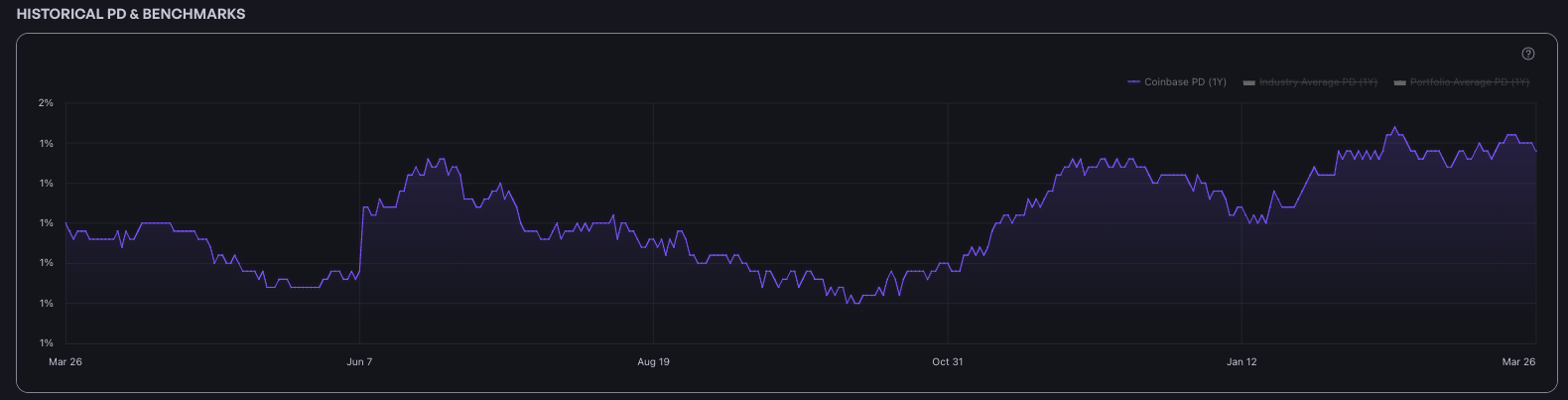

Across a portfolio, the Risk Simulator models credit losses across 1 million+ Monte Carlo simulations, incorporating correlation and contagion risk across counterparty allocations.
Agio Ratings covers 70+ exchanges and custodians with continuous updates. The v3.2 CEX risk model processes 17 risk indicators per exchange, updated daily. Risk teams at Wintermute, Ledn, and Relm Insurance already use Agio Ratings for counterparty risk assessment.
For institutions building or managing crypto exposure, Agio Ratings provides a quantitative framework for exchange risk where legacy providers still offer limited coverage.
Frequently Asked Questions
What is the safest crypto exchange by default risk?
Coinbase carries the lowest 12-month probability of default at 1.44% under Agio Ratings' v3.2 model.
How does Agio Ratings measure exchange default risk?
Agio Ratings scores 17 risk indicators per exchange, spanning on-chain data, operational metrics, and regulatory signals. The v3.2 model identifies five latent risk dimensions in the data and extracts the shared credit risk signal across all five to produce a single 12-month probability of default.
Is Coinbase safer than Binance?
Based on v3.2 data, yes. Coinbase carries a 1.44% probability of default versus Binance's 1.70%. The gap reflects Coinbase's stronger maturity and licensing profile, while Binance scores higher on operational flow metrics.
How did Bybit rank in the top 8 after a $1.5 billion hack?
The Agio Ratings model measures an exchange's structural ability to absorb shocks, not just whether a shock has occurred. Agio Ratings began tracking Bybit in March 2025 and recorded a PD around 4%, which later declined as the exchange stabilized.
Can traditional credit agencies assess crypto exchange risk?
Traditional agencies like Moody's and S&P cover only a small number of publicly traded crypto companies and do not provide broad exchange-level ratings across the market. Their models also lack crypto-specific inputs like on-chain reserve verification and wallet behavior analysis.
What's the difference between exchange default risk and custody risk?
Both represent counterparty credit risk, but the exposure profiles differ. Exchange defaults typically involve trading losses, liquidity stress, or insolvency. Custody risk centers more directly on safekeeping, operational failures, and asset segregation.
What are the best alternatives to Coinbase?
Binance carries the next-lowest default risk at 1.70%, followed by OKX at 2.09% and Crypto.com at 2.81%.
What changed in Agio Ratings' v3.2 model?
The update recalibrated average default rates, changed the weighting methodology to extract a shared credit risk signal from five latent dimensions, and widened the spread between stronger and weaker credits.
How does regulation affect exchange safety?
Regulatory strength is one of five latent risk dimensions in the v3.2 model. Exchanges with stronger oversight and broader licensing tend to score lower on default risk.
How can risk professionals access live exchange ratings?
Agio Ratings' platform provides daily updated scores across 70+ exchanges and custodians, along with anomaly alerts and portfolio modeling tools for continuous monitoring.