Tether manages roughly $190 billion in reserves. It only reports on them once a quarter. A lot can change in that time: stablecoins are issued and redeemed, market prices and rates shift, and the portfolio drifts.
Without a quantitative framework to track these changes, anyone with exposure to USDT is left estimating the reserve ratio and the equity buffer, and guessing whether the issuer is still fully collateralised. For a trading or treasury desk holding USDT, that gap matters most precisely when markets move fast and the last attestation is already weeks old. Today, Agio Ratings is closing it, so risk managers and front-office teams can manage direct and indirect stablecoin risk with confidence.
Introducing Stablecoin Reserves Modeling (SRM)
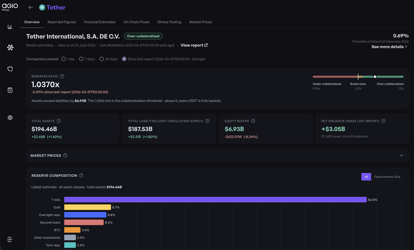
Starting from the issuer's most recent attestation, the model estimates the reserve position every day during the inter-attestation period, until the next report resets the anchor. SRM combines publicly reported figures, daily on-chain token issuances and redemptions, market prices, and asset-level accrual logic to keep the picture current.
The result is a daily updated view of the issuer's balance sheet: total reserves broken down by asset class, total liabilities, equity buffer, reserve ratio, and liquidity ratios.
A word on scope. SRM measures the issuer's reserve adequacy, not the token's market peg. It tells you how much cushion backs USDT between attestation dates, not whether the token is trading a cent above or below a dollar on a given exchange.
SRM launches today for Tether (USDT), with Circle (USDC) following in H2 2026.
What the Model Produces
On any given day, Agio Ratings publishes the data institutional users need to monitor stablecoin counterparty risk continuously:
- Reserve ratio and equity buffer: is the issuer over- or under-collateralised relative to its outstanding token supply, and by how much
- Reserve composition: estimated asset breakdown across U.S. Treasury bills, cash, overnight or term reverse repurchase agreements, gold, Bitcoin, secured loans, and other categories
- Daily issuances and redemptions: on-chain token flows that update the issuer's liability estimate in real time
- Liquidity ratios: the share of outstanding liabilities covered by near-cash and liquid assets
- Stress testing: apply simultaneous price shocks to Bitcoin and gold and see the immediate impact on the reserve ratio and equity buffer under adverse market conditions
Historical attestation data sits alongside the model estimates, so users can see exactly where the model resets and track its accuracy over time.
Built for Institutions, Documented for Scrutiny
Most stablecoin risk tools produce periodic scores or qualitative opinions. They were not built to detect deteriorating reserve adequacy between attestation dates, or to give risk teams a quantitative basis for assessing how much cushion stands between the issuer and under-collateralisation.
The model is designed to meet the documentation and auditability standards that institutional risk teams and their regulators increasingly require. For institutions operating under the GENIUS Act, the US stablecoin framework, or equivalent regimes elsewhere, SRM provides the kind of structured, traceable reserve monitoring that periodic attestations alone cannot deliver.
Stablecoin Reserves Modeling complements our existing Fundamental Ratings, which produce a point-in-time Probability of Default and Loss Given Default for stablecoin issuers. The Fundamental Ratings tell you how likely an issuer is to fail and what you would lose if it did; SRM shows you, day by day, how the reserves behind that judgment are moving. Together, they offer the most complete framework available for continuous stablecoin issuer reserve monitoring and credit risk assessment.
Explore the Model
Stablecoin Reserves Modeling is live from Tuesday, June 9, 2026 on the Agio Ratings platform. Existing clients can access it now through the web portal and API.
If you would like to see how SRM fits into your counterparty risk process, book a demo or get in touch at contact@agioratings.io.